AI food photography: prompts, light and styling that make food look delicious
How to get AI food images with real appetite appeal: the texture and light cues food photographers rely on, which angle suits which dish, motion for social, and where AI belongs (and doesn't) on a menu.
Updated · 11 min read · By the PromptLab team
The short version
- Appetite appeal comes from physical cues: gloss, steam, texture, crumbs and freshness. Name them in the prompt; words like delicious do little.
- Light food from behind or from the side. Backlight makes steam, syrup and sauces glow; side light shows crust and crumb.
- Choose the angle by the dish: straight-on for tall food, about 45 degrees for plated dishes, overhead for bowls, boards and spreads.
- Surreal concept food is for attention on social. Menu and delivery-app photos must show the dish the customer actually gets.
- For real dishes, photograph the plate and use AI to improve light and background, not to change the food.
In this guide
Where AI food photography fits, and where it doesn't
Food images do two different jobs, and AI fits them very differently. The first job is attention: a launch teaser, a social post, a seasonal campaign, a mood board for a new menu. Here the image sells an idea or a feeling, and AI is excellent. You can try ten concepts and three lighting moods before a stylist would have finished shopping for props.
The second job is representation: the photo on a menu, a delivery app or a package. That image is a promise about what the customer will get. A generated dish that looks better, bigger or different from the real one is a misleading claim, however good it looks. For that job, AI is a retouching and set-building tool around a photo of the real plate, not a replacement for it.
| Use | AI role |
|---|---|
| Social posts, ads, launch teasers | Generate freely: concepts, surreal food, motion clips |
| Mood boards and shoot planning | Generate freely, then brief a photographer or stylist |
| Menus, delivery apps, packaging | Edit around a real photo of the dish; never invent the food |
Everything below applies to both jobs. The techniques that make a generated dish look delicious are the same ones you use to improve a real one.
Appetite appeal: the cues that make food look edible
People judge food in a photo by surface cues that signal temperature, freshness and texture: is it hot, is it crisp, is it juicy, was it just made? Food photographers spend most of their effort on exactly those cues. Models respond to them too, because they are concrete and visible, unlike "delicious" or "mouth-watering", which describe a reaction rather than a picture.
Macro shot of golden honey pouring slowly over a stack of pancakes, glistening, soft morning light, vertical food video
This five-second clip has almost no subject matter: honey and pancakes. What makes it work is that every word describes something you can see. "Glistening" asks for specular highlights on the honey. "Macro" brings the camera close enough to show the bubbly crumb on the pancake edges. "Pouring slowly" gives the honey time to pool on top and then run down the side of the stack.
Here are the cues worth naming, and words that reliably produce them:
| Cue | Signals | Prompt words |
|---|---|---|
| Gloss | Juicy, freshly sauced | glistening, glossy glaze, sauce sheen |
| Steam | Hot, just served | wisps of steam rising, backlit steam |
| Texture | Crisp or tender | crackling crust, flaky layers, charred edges, open crumb |
| Imperfection | Real, handmade | scattered crumbs, a drip on the rim, uneven browning, torn edge |
| Freshness | Cold, crisp, just picked | condensation droplets, dew on herbs, frost on the glass |
| Interior | Generosity, flavor | cut cross-section, cheese pull, runny yolk |
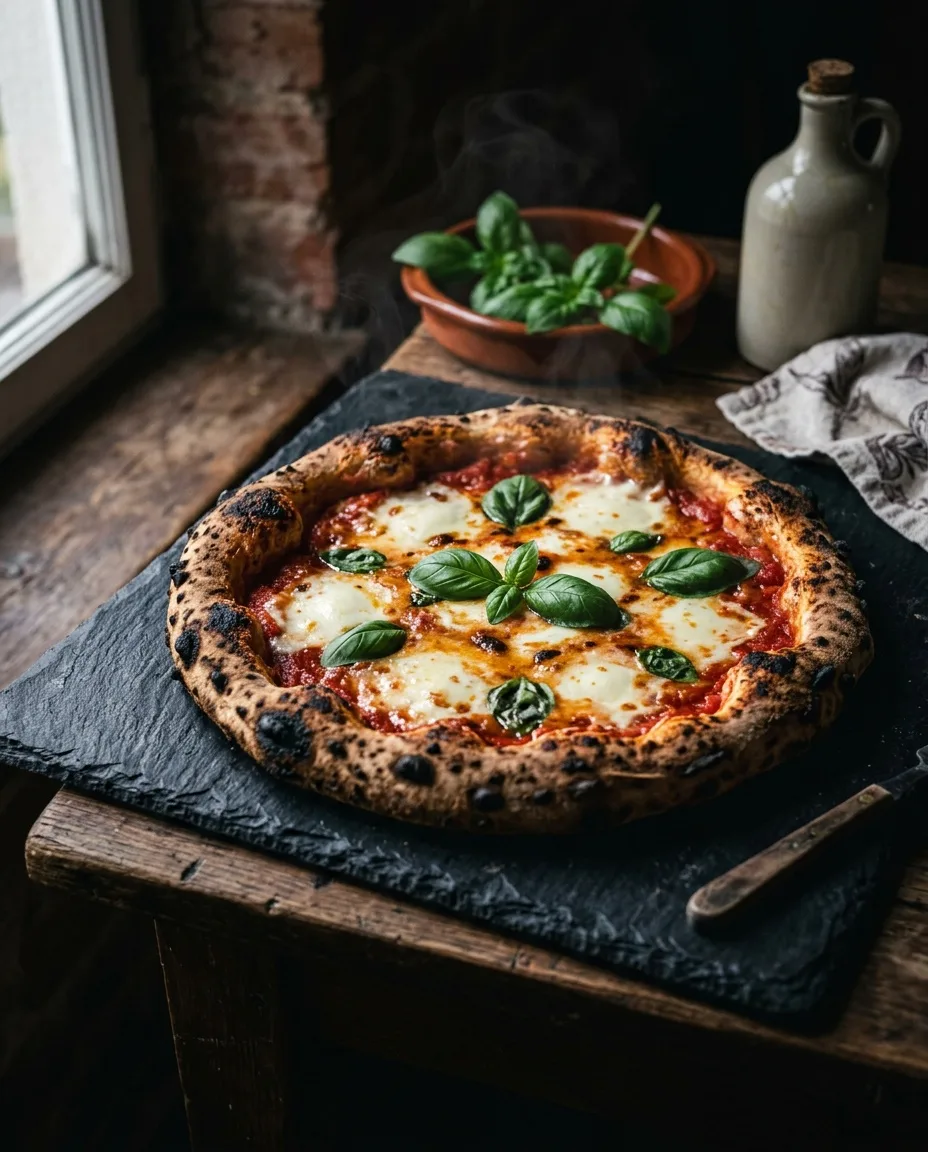
The pizza at the top of this page is what those cues do for a realistic shot. Its prompt is close to a checklist from the table: texture, gloss, steam, a light direction and an angle.
Wood-fired margherita pizza with a blistered, charred crust and glossy melted mozzarella, fresh basil leaves, on a dark slate board, side light from a low window, wisps of steam, 45-degree angle, dark and moody food photography
- Subject what the picture is of
- Detail materials, wardrobe, texture
- Setting where, and what surrounds it
- Light source, direction, time of day
- Camera lens, angle, framing, focus
- Style medium, genre, reference
Every cue shows up. The crust has the dark leopard spotting of a wood-fired oven, uneven from one side of the rim to the other, the mozzarella has melted into glossy pools with orange oil at the edges, and faint steam rises against the dark wall. The low window on the left rakes across the crust and leaves the far side of the room in shadow. The model also styled the table without being asked: a terracotta bowl of basil, a stoneware jug, a printed linen napkin and an old knife. It reads as a real food photograph, which is the point, and also the warning: it is a pizza, not your pizza, so it belongs on a mood board or a social post, not on a menu.
How to light AI food photos: backlight and side light
Food is rarely lit from the camera position. Front light flattens texture and kills the shine on sauces. Food photographers mostly use two directions instead:
- Backlight (light behind the food, facing the camera): makes steam, syrups, drinks and anything translucent glow, and puts a bright rim on edges. The classic look for drinks and hot dishes.
- Side light (light from the left or right, often low): rakes across the surface and reveals crust, crumb, grain and seeds. The classic look for bread, pastry and meat.
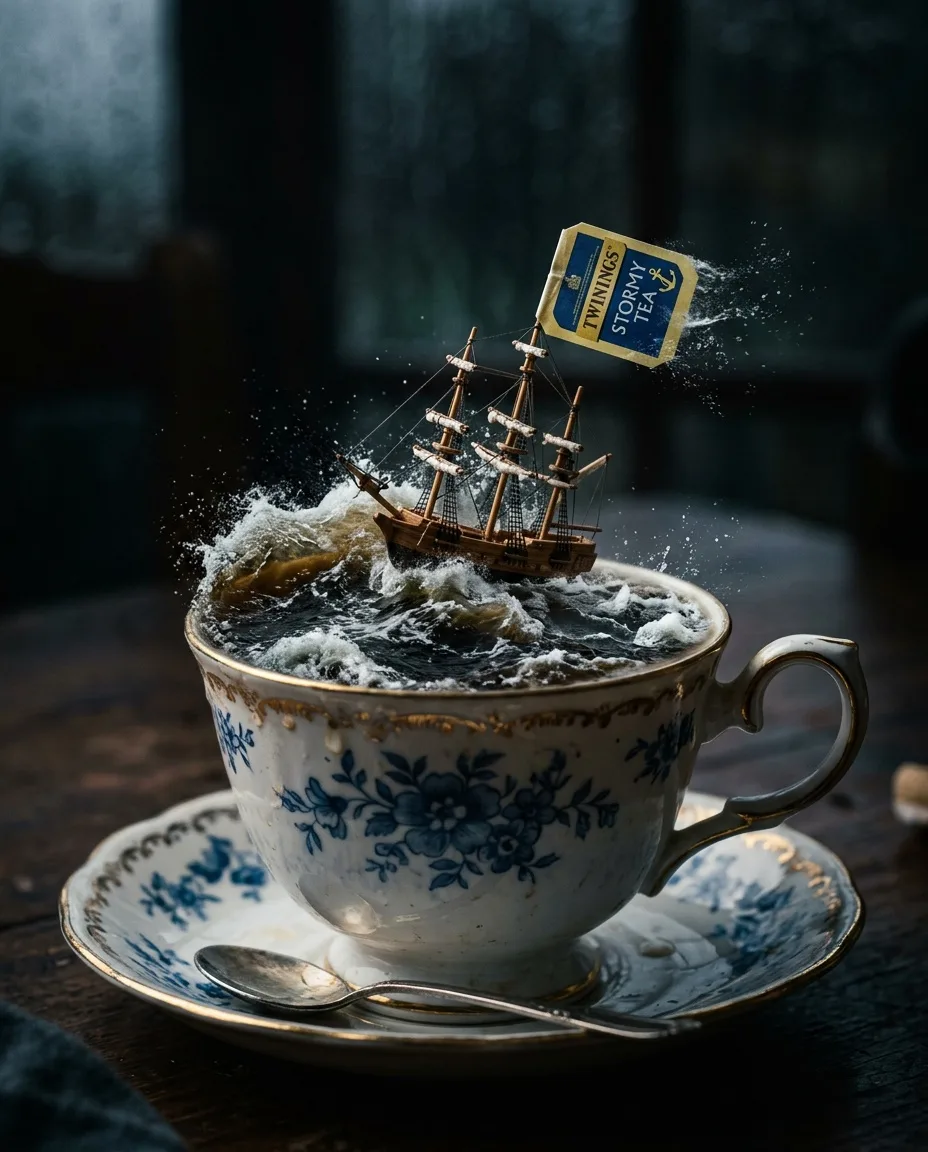
A porcelain teacup containing a miniature stormy ocean with a tiny sailing ship riding a wave of tea, the teabag tag flying like a flag, dramatic lighting, macro
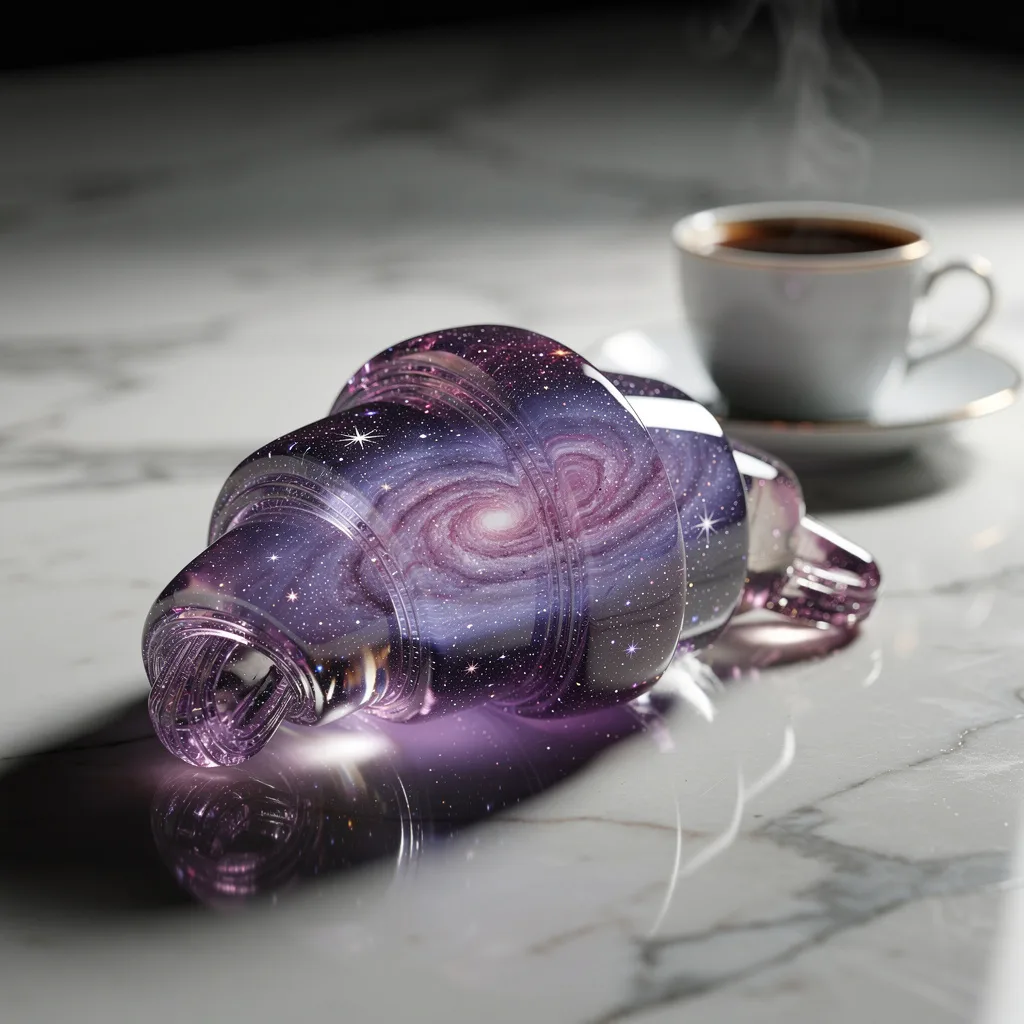
A croissant made of translucent glass, inside it a swirling purple galaxy with tiny stars, on a marble counter next to an espresso cup, macro food photography, dramatic rim light
The teacup asks only for "dramatic lighting", and the model chose a dark, low-key set with a window behind the cup, so every droplet of spray catches the light. The glass croissant shows hard side light: one bright direction, a long shadow across the marble and a bright edge on the glass. Note the steam rising from the coffee cup behind it, added without being asked; it is a strong "freshly made" signal.
Useful light phrases for food, from dark to bright:
- "Dark and moody, low-key, window light from behind": rustic dishes, coffee, chocolate, red wine.
- "Side light from a low window, long soft shadows": bread, pastry, breakfast.
- "Bright and airy, diffused daylight": salads, brunch, desserts, healthy brands.
- "Hard summer sunlight, crisp shadows": cold drinks, ice cream, picnic food.
Hero angle, 45 degrees or overhead flat lay?
The camera angle should follow the shape of the dish. Ask where the interesting part is: on the side (layers, height), on top (arrangement, toppings) or both.
| Angle | Best for | Prompt words |
|---|---|---|
| Straight-on hero | Tall food: burgers, layer cakes, stacks, cones, drinks | eye-level shot, straight-on, low angle |
| About 45 degrees | Plated dishes, pasta, bowls with height, desserts | 45-degree angle, three-quarter view, diner's point of view |
| Overhead flat lay | Flat food and spreads: pizza, boards, sushi, table scenes | overhead shot, top-down flat lay |
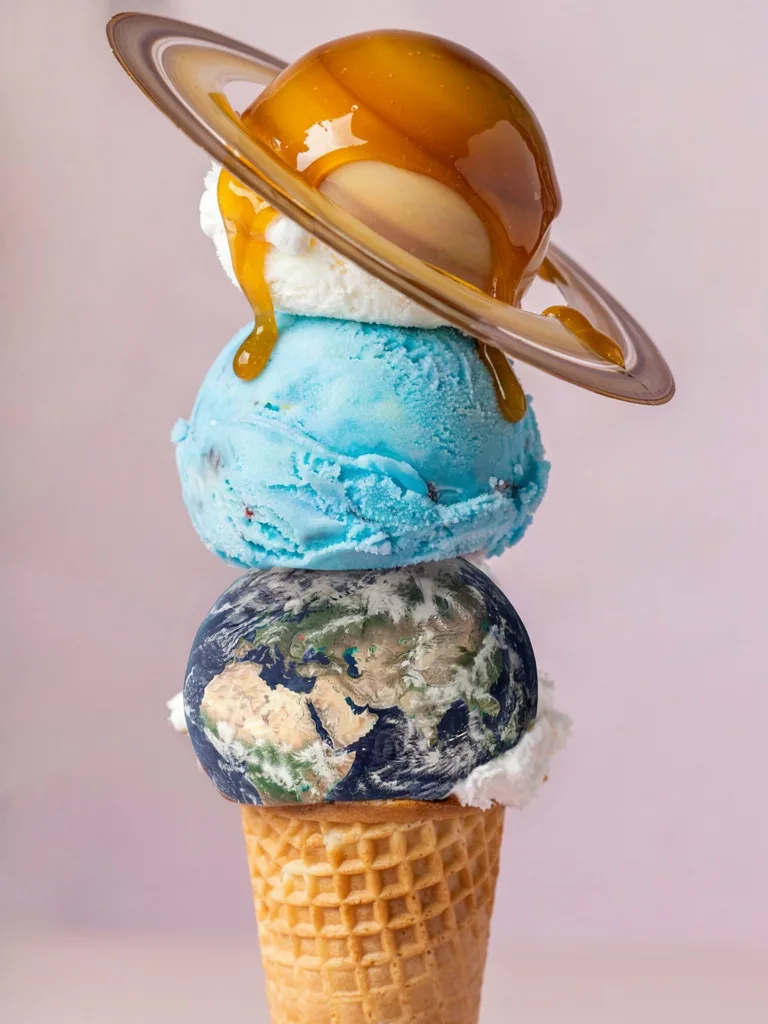
An ice cream cone where each scoop is a miniature planet, Saturn with rings dripping caramel, Earth with whipped-cream clouds, pastel studio background, playful product photography
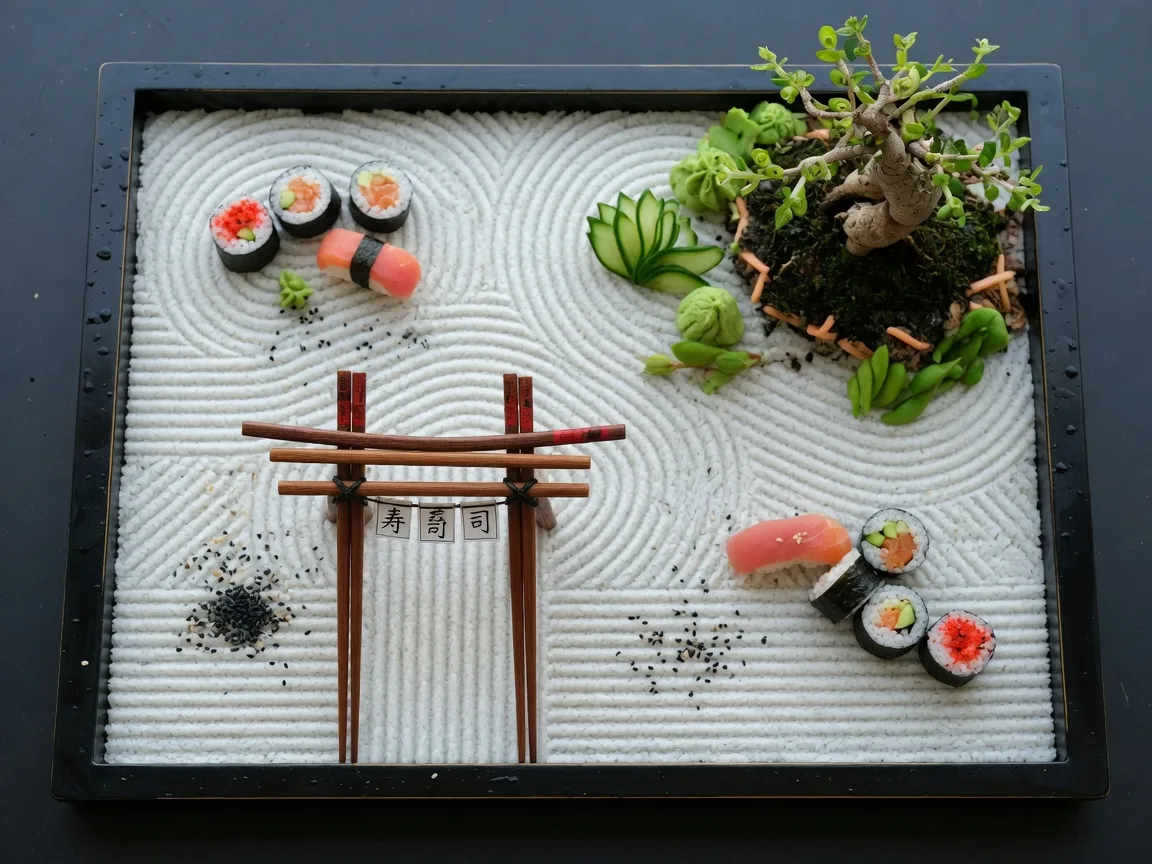
A sushi platter arranged as a tiny Japanese zen garden, raked rice sand, a bonsai made of wasabi, a miniature torii gate of chopsticks, overhead shot, soft daylight
The ice cream cone is all height, so a straight-on shot against a plain pastel backdrop shows every scoop. The sushi platter is all arrangement: from overhead, raked rice becomes a graphic pattern and the chopstick gate reads as a shape. The pizza at the top breaks the table on purpose: one pie at 45 degrees shows the height of the puffed crust, which an overhead shot would flatten. One caution from the sushi image: the model hung a little sign with the characters for "sushi" and a malformed character between them. Check any lettering a model adds.
Food styling, props and plating in the prompt
Styling is everything around the food: the plate, the surface, the cutlery, the napkin, the second cup of coffee. Models know common food-styling conventions well, and they will apply them unasked. That can be a gift or a problem.
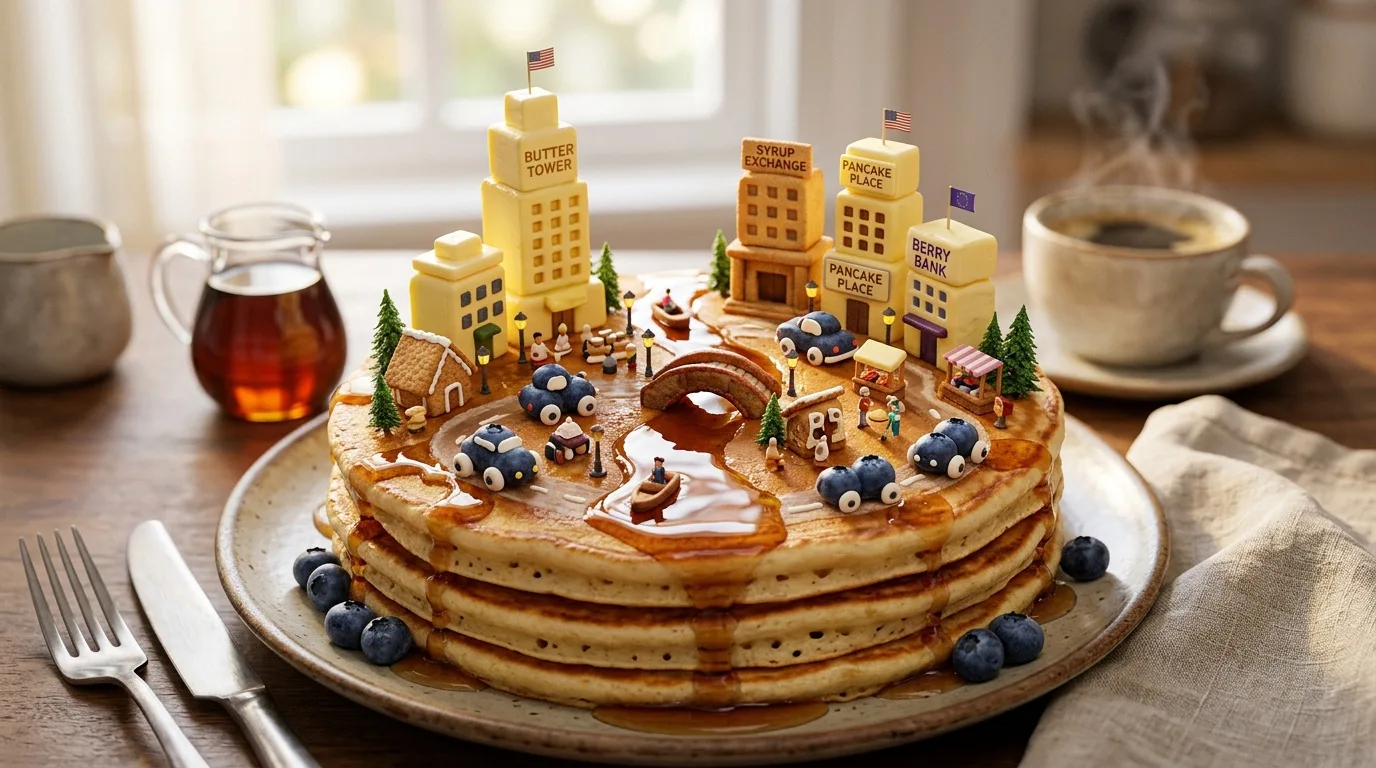
A miniature city built on a stack of fluffy pancakes, maple-syrup rivers, butter-pat skyscrapers, blueberry cars, tilt-shift photography, morning light
- Subject what the picture is of
- Detail materials, wardrobe, texture
- Camera lens, angle, framing, focus
- Light source, direction, time of day
The prompt names the food and the concept, and nothing about the set. The model supplied a whole breakfast table anyway: a syrup jug, a steaming coffee cup, a knife and fork, a linen napkin, scattered blueberries and a bright window behind. That is textbook styling, and it is why the image feels warm. It also added lettering to the butter towers and reused one name, and the tilt-shift look barely came through: the background is blurred, but there is no miniature-style focus band.
The rule: if you care about the set, specify it. A few styling principles worth writing in:
- One hero, few supporting props. Props should come from the dish's story (its ingredients, its cuisine, how it is eaten), not from a generic kitchen.
- Odd numbers and negative space. Three berries look arranged by a person; four look like a grid. Leave clear space where an ad's headline will go.
- Color contrast. Blueberries against golden pancakes, green herbs on a red sauce. A complementary garnish makes the main color look richer.
- Quiet tableware. Matte, neutral ceramics and plain linen keep attention on the food.
- Garnish only with what is in the dish. A sprig of an herb that isn't in the recipe is a small lie on a menu.
[dish] with [two texture cues], served in [vessel] with [garnish from the recipe], on [surface], [one or two props from the dish's story], [backlight or side light], [angle], [dark and moody / bright and airy] food photography, [aspect ratio] for [channel]
Motion for social: pours, drips and steam
Short, slow, satisfying motion is a staple of food content on social: a pour, a drizzle, a cheese pull, steam curling off a bowl. These clips work because they show texture and temperature better than any still, and they loop well.
The honey clip earlier in this guide was generated directly from text on PixVerse V6, as a five-second 9:16 vertical, for 57 credits. The camera is effectively locked off, which is right for this kind of shot: the motion belongs to the food.
Macro shot of [liquid or topping] [pouring / drizzling / dripping / melting] slowly over [dish], [texture cue], [light], slow motion, static camera, vertical food video
For your own dish, start from a photo of it and use image-to-video, so the food stays exactly as served and you only direct the motion. Here we animated the pizza still on the same model. The prompt describes only what moves, because the image already fixes everything else.
Wood-fired margherita pizza with a blistered, charred crust and glossy melted mozzarella, fresh basil leaves, on a dark slate board, side light from a low window, wisps of steam, 45-degree angle, dark and moody food photography
Steam rises slowly from the pizza, the mozzarella glistens, slow push-in, then settles
The pizza itself stays the same pizza: same crust spots, same basil, same pools of cheese. Steam drifts up on the left and the cheese catches the light. The push-in is stronger than "slow" suggests: by the last second the frame is a tight close-up on the center of the pie, the props have left the frame, and the motion only eases off at the very end. That works for a vertical crop on social; if you need the whole table in the final frame, ask for a locked-off camera or a gentler move and check the last frame, not just the first. It cost 57 credits.
Our image-to-video prompting lesson covers how to write motion prompts, and the guide to AI video ads for social covers hooks and testing.
Concept food: surreal shots that stop the scroll
Surreal food is where AI is unmatched: a burger made of clouds, a bowl of ramen as a swimming pool, a coffee bar run by an octopus. These are attention images for social and campaigns, not menu photos, and they live or die on one rule: keep the food recognizable.

A gourmet burger where every layer is a different kind of cloud: cumulus bun, stormy-grey patty with tiny lightning, sunset-coloured sauce, floating above a plate, surreal food photography
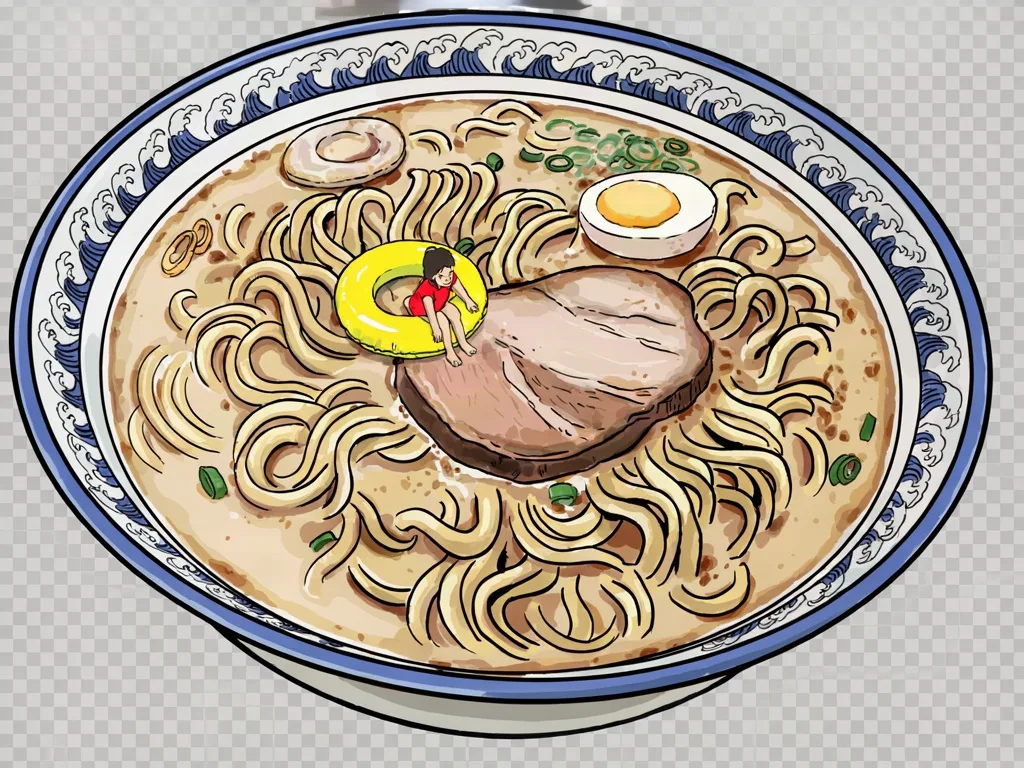
A tiny person in a swim ring floating in a giant bowl of tonkotsu ramen, noodles as waves, a chashu slice as a lounger, bright pop-art colours, playful
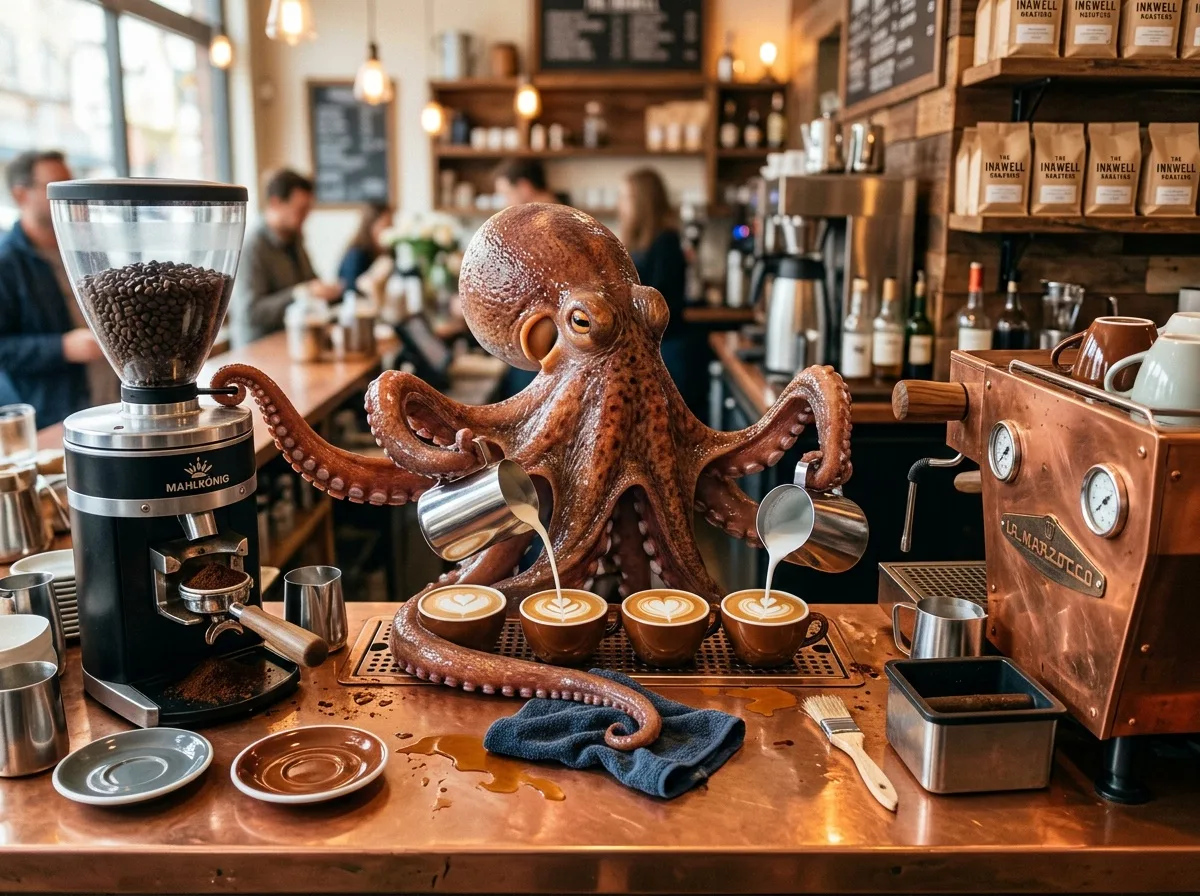
An octopus barista behind a copper espresso bar pouring four latte-art hearts at once with four arms while two more arms grind beans and one wipes the counter, warm café light, photorealistic
- The cloud burger works because the stack order is still bun, patty, sauce, bun. You read "burger" before you read "clouds".
- The glass croissant in the lighting section is the counterexample: the galaxy and the light are beautiful, but the shape reads as a glass horn rather than a croissant. When you transform a food, name its defining features ("crescent shape, laminated layers") so the silhouette survives.
- The ramen pool came back as a flat pop-art illustration, and the model painted a grey transparency checkerboard into the background, a known artifact. Check the edges before you post.
- The octopus barista is a convincing café, but the grinder and espresso machine carry real equipment brand names that nobody asked for. In a commercial post, that is a trademark problem.
A [familiar dish] where [one element] is made of [surprising material or world], keeping its [defining shape and features], on [real surface] with [one real prop], [light], [food photography / pop-art illustration]
AI food photos for menus and delivery apps: keep them honest
Advertising rules treat a food photo as a claim about the product. In the UK, the Advertising Standards Authority looks at the overall impression an ad gives, images included, and its guidance says pictures that exaggerate the size or quality of a product, or show extras that don't come with it, are likely to mislead. In one well-known ruling, the ASA cooked the advertised product itself and found the ad showed more pasta and mushrooms than the real thing. In the US, the FTC Act prohibits deceptive advertising in general. Delivery platforms also publish their own photo guidelines, so check the one you list on.
A generated dish on a menu fails this test almost by definition: it shows a dish, not your dish. The honest workflow keeps the food real and uses AI for everything around it.
Photograph the real plate
Plate it exactly as served, same portion and garnish. A phone in daylight is enough. Use the angle from the table above that suits the dish.
Edit around it
Use an image-editing model with the photo as the reference to change the surface, background and light. Say explicitly to keep the food unchanged.
Compare against the plate
Put the edit next to the original. Same portion, same components, same garnish, no added steam on a cold dish? If the food changed, redo the edit.
Keep the originals
Store the source photo with the final, so you can show how any menu image was made.
Do
- Concept and mood images for social, ads and launches
- New backgrounds, surfaces and light around a real photo of the dish
- Portion, components and garnish that match what is served
- AI labels wherever a platform asks for them
Avoid
- Fully generated dishes on a menu or delivery listing
- Bigger portions, extra toppings or sides that are not included
- Real brand logos the model invented on cups, tags or machines
- A garnish or ingredient that is not in the recipe
What AI food photography costs
Every food image and clip in this guide, with what it cost to render. The spread is wide: the cheapest images cost 3 credits and the most expensive 20. The two clips are in the last rows.
| Render | Model | Credits | Plan value | Per second |
|---|---|---|---|---|
| Wood-fired margherita pizza with a… | Nano Banana 2 | 20 | $0.20 | — |
| A sushi platter arranged as a tiny… | Grok Imagine | 13 | $0.13 | — |
| An ice cream cone where each scoop… | Ideogram 4 | 3 | $0.03 | — |
| A tiny person in a swim ring… | Ideogram 4 | 3 | $0.03 | — |
| A croissant made of translucent glass | Flux 2 Pro | 8 | $0.08 | — |
| A miniature city built on a stack of… | Nano Banana 2 | 20 | $0.20 | — |
| A gourmet burger where every layer… | Nano Banana 2 | 20 | $0.20 | — |
| A porcelain teacup containing a… | Nano Banana 2 | 20 | $0.20 | — |
| An octopus barista behind a copper… | Nano Banana 2 | 20 | $0.20 | — |
| Macro shot of golden honey pouring… | PixVerse V6 · 5 s | 57 | $0.57 | 11 cr |
| Steam rises slowly from the pizza | PixVerse V6 · 5 s | 57 | $0.57 | 11 cr |
A sensible workflow is to explore concepts, angles and light on the cheapest models, then render the chosen direction on two or three stronger models and keep the best. In PromptLab, the Benchmark runs one food prompt on up to four models side by side, and our four-model comparison shows how differently models read the same brief. Current prices are in the model catalog.
Questions people ask
Can I use AI-generated food photos on my restaurant menu?+
Only if they accurately show the dish customers receive. Advertising rules treat menu photos as claims, so a generated dish that differs in portion, ingredients or garnish can mislead. The safer route is to photograph the real plate and use AI to improve the light and background.
What are good prompts for AI food photography?+
Name the dish, two or three texture cues such as glossy glaze or flaky layers, the plating and surface, a light direction such as backlight or side light, the camera angle and a mood. Words like delicious or appetizing add little.
What is the best angle for food photography?+
Shoot tall food like burgers, stacks and drinks straight-on, plated dishes at about 45 degrees, and flat food, boards and table spreads from overhead.
How do I make AI food images look real?+
Ask for small imperfections such as crumbs, drips and uneven browning, light from behind or the side, and keep props few and relevant. Then check at full size for warped cutlery, melted shapes and invented text or logos.
Do AI food photos need to be labeled on social media?+
Often, when they look realistic. TikTok, YouTube and Meta all label or ask for disclosure of realistic AI-generated content, and their rules changed during 2026, so check each platform's current policy before posting, especially for ads.
Keep learning
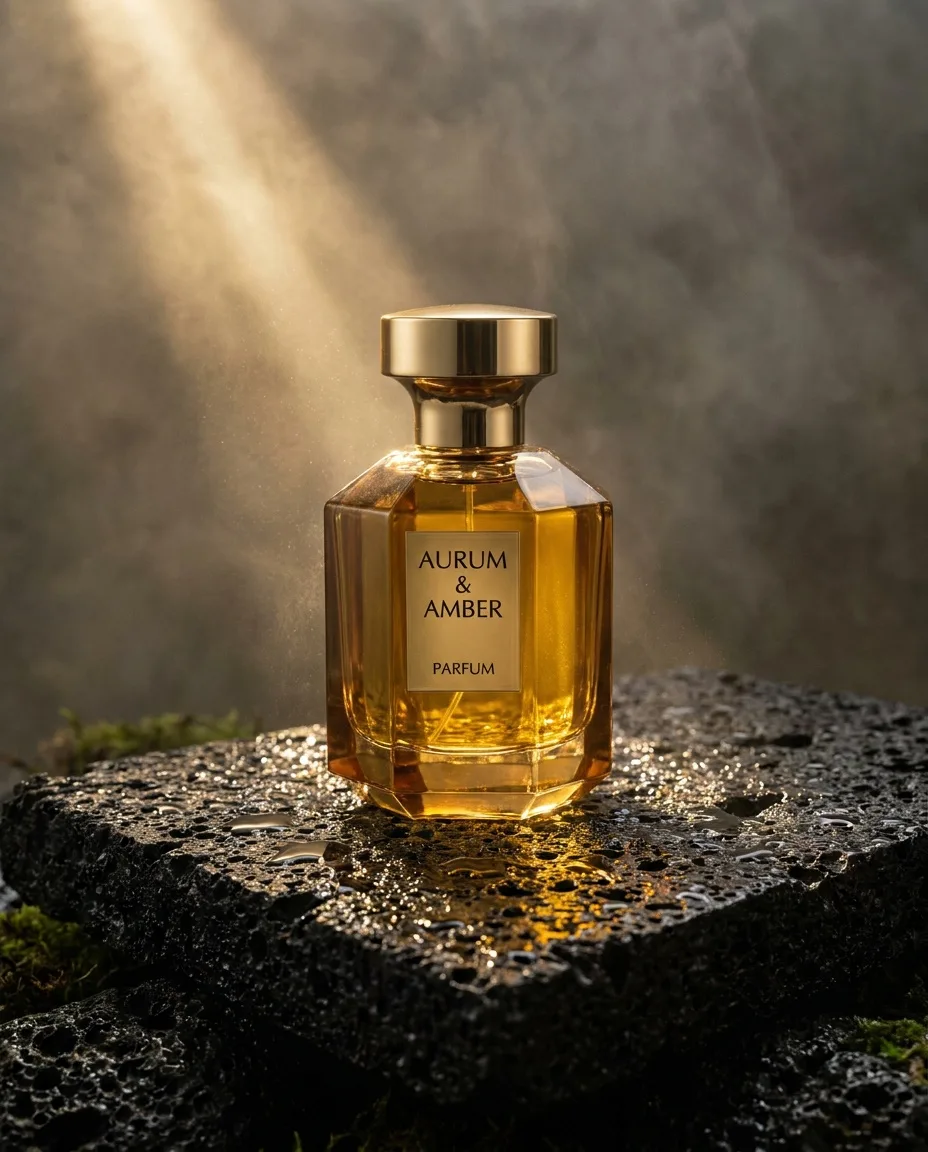
AI product photography: prompts, light and packshots that sell
A practical guide to AI product shots that look like a campaign rather than a stock photo: how to structure the prompt, pick a surface, light it like a photographer, and keep your real product accurate.
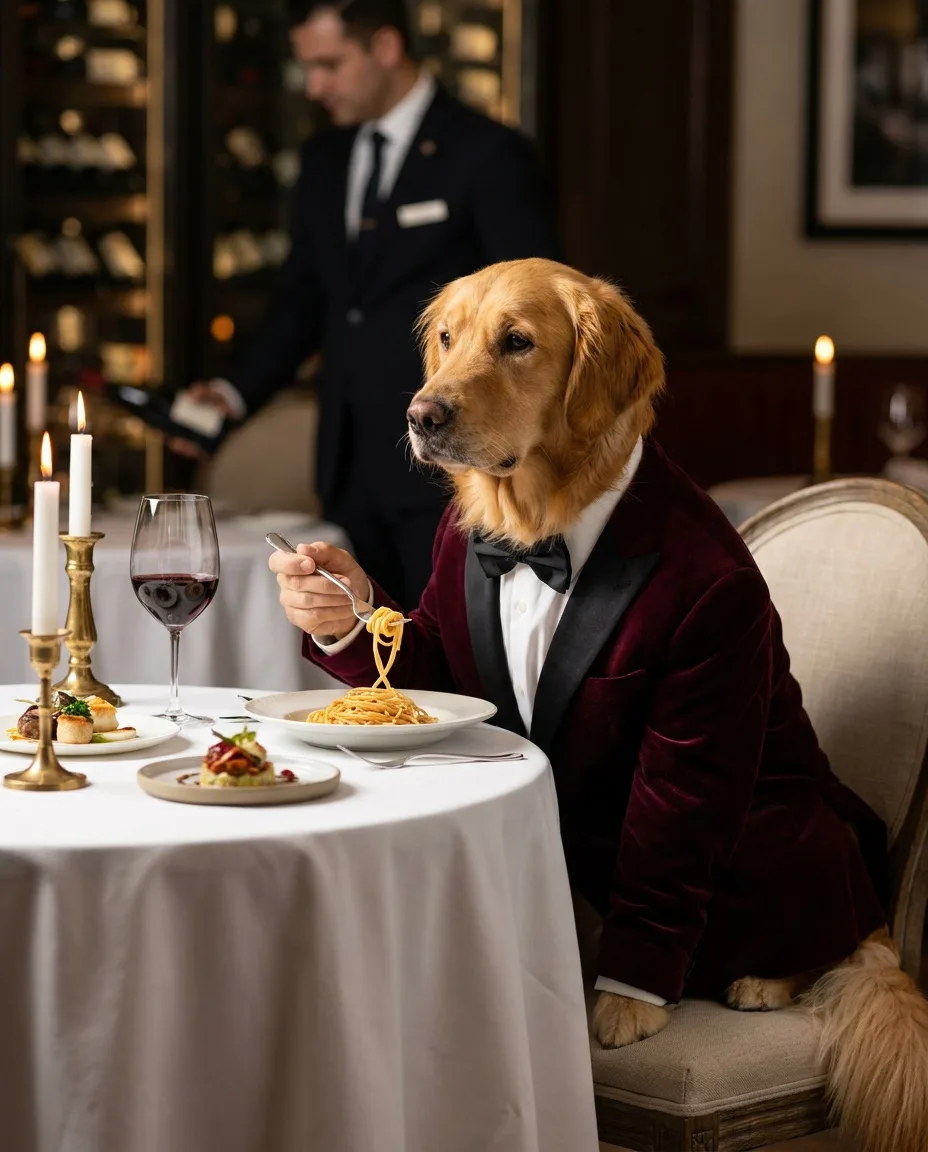
How to write image prompts: the anatomy, words and habits that work
A practical text-to-image prompt guide built on real renders: the order to write things in, the camera and style words that visibly change a picture, how to make AI images look real, and how to turn a good prompt into a reusable template.
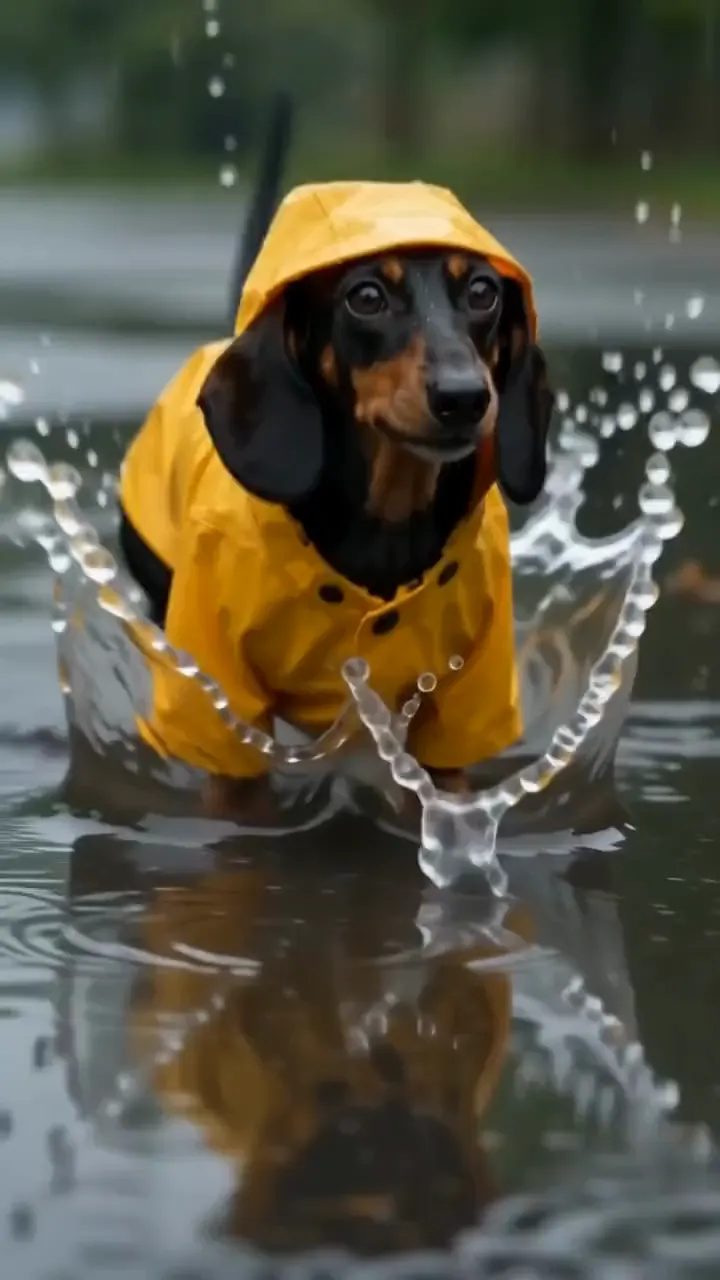
AI video ads: how to make vertical ads and UGC-style content that stop the scroll
A practical playbook for short vertical ads made with AI video models: what a hook needs in the first second, how to generate ten variants on an inexpensive model, how to test them, and where the legal lines are for UGC-style ads.
Run these prompts on every model, side by side.
PromptLab puts Flux, Nano Banana, Kling, Veo, Seedance and dozens more in one workspace. See the cost before you click, keep the prompts that win.